Calculating water levels in a watercourse is a scientific task that relies on a combination of hydrological principles and measurement techniques. These principles include understanding the watershed, analyzing precipitation, studying flow rates, and monitoring seasonal changes. Instruments like limnimeters and hydrometric radars are often employed to obtain accurate data. The information collected is crucial for water resource management, flood prevention, and environmental planning. The accuracy of these measurements directly influences decisions regarding land use and public safety.
Modern Methods of Water Level Calculation
In the arsenal of hydrological techniques, methodologies for calculating water levels are constantly evolving, marked by the integration of sophisticated technologies. Flow gauging, for example, now relies on the ADCP (Acoustic Doppler Current Profiler), a cutting-edge device for accurately and efficiently measuring the volume of water passing through a section of a watercourse per unit of time. This technology captures the speed of water particles at different points and, through calculations, establishes a flow profile. Consider the precision that the ADCP brings: a revolution in hydrometry, providing reliable data even under turbulent flow conditions or during sudden changes in the water thread.
At the same time, LSPIV (Large Scale Particle Image Velocimetry) is emerging as an innovative technique in hydrology and hydraulics. Using video imaging, LSPIV analyzes the movement of particles on the water’s surface, allowing for the estimation of river flow, particularly during floods. This imaging process, combined with advanced analysis software, transforms our ability to monitor watercourses, enriching our understanding and responsiveness to extreme natural events.
The convergence of these technologies, amplified by the use of numerical modeling and forecasting systems, profoundly alters practices in hydrometry. The complementarity between in situ measurements and remote analyses, via satellite or radar, contributes to a more comprehensive and dynamic picture of watercourses, essential for water resource management and flood risk prevention. These innovations, at the heart of environmental concerns, drive integrated and preventive management of watersheds.
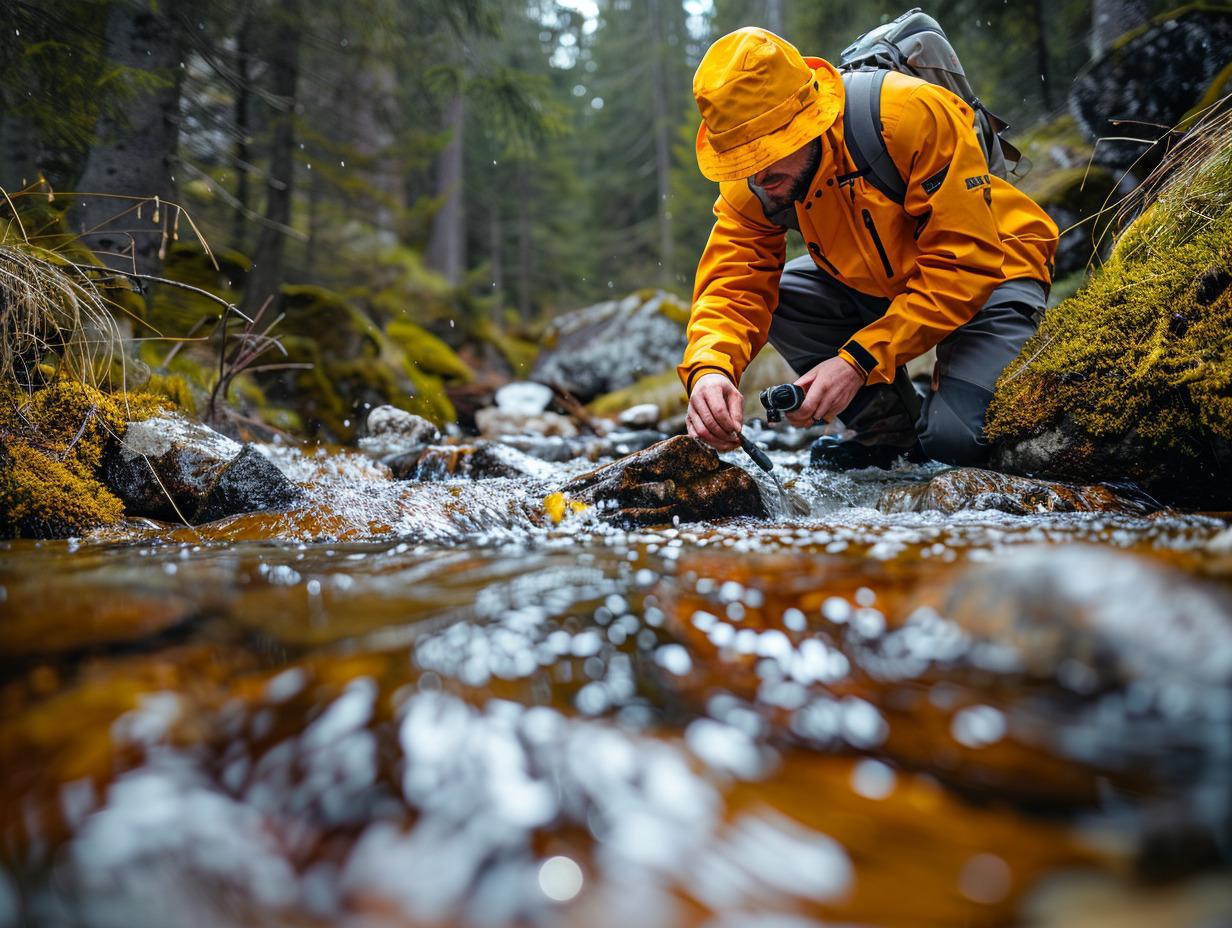
The Challenges of Water Resource Management and Risk Prevention
Mastering the flow of watercourses is of unprecedented importance in the face of the challenges posed by climate change and the preservation of biodiversity. Water resource management is becoming a key element for the future of vital sectors such as agriculture and energy production. The Amazone River, with its extremely regular flow, contrasts with the Chari River, which exhibits more pronounced fluctuations, directly affecting the Chad Lake into which it flows.
Monitoring precipitation and its influence on watercourse flows is essential for anticipating floods, which are often synonymous with disasters. Services such as Vigicrues, established by the Ministry of the Environment, and the SCHAPI (Flood Forecasting Service), provide fundamental information for flood risk prevention. The hydrometric stations, dotted along rivers, form an indispensable network for monitoring water levels, allowing for rapid and appropriate responses in the event of rising waters.
Understanding fluctuating hydrological regimes is even more imperative as climate change alters traditional parameters. The BSH (Hydrological Situation Bulletin) and the Wave (National Low Water Observatory) provide monitoring and analysis tools to assess the long-term health of aquatic ecosystems, ensuring the sustainability of natural environments and the biodiversity they harbor.
The challenges of water resource management and risk prevention are intrinsically linked to the ability to measure and understand the flows of watercourses. A challenge that cutting-edge technologies and environmental management policies must jointly address to ensure a balance between human needs and the preservation of ecosystems.